On-Page SEO: The Ultimate Optimization Guide for 2026
On-page SEO makes each page easy for search engines to understand and for users to act on — through search intent, strong titles and headings, readable content, clean URLs, internal links, images, and schema.
Sahar
Content Writer
If you want better rankings, more clicks, and stronger organic traffic, on-page SEO is where your page improvement starts. It helps search engines understand your content and helps users find clear answers. In 2026, good optimization means better structure, useful content, clean links, fast pages, and strong search intent.
Need this done right?
Hoop builds the strategy, design and development behind sites like this one — talk to us about yours.
What Is On-Page SEO?
On-page SEO is the process of optimizing the visible and hidden parts of a web page so it can rank better in search engines. It includes your content, title tags, meta descriptions, headings, keywords, URLs, images, internal links, schema markup, and user experience.
In simple words, on-page SEO optimization helps Google and users understand what a page is about.
For example, if you have a service page about local SEO, the page should make that topic clear from the start. The title should include the main keyword. The headings should guide the reader. The content should answer real questions. The links should help users move to related pages. The page should also load fast and work well on mobile.
That is how strong website optimization works.
Older SEO was often about adding keywords again and again. That no longer works. In 2026, search engines are better at understanding meaning, context, and user intent. So your page must be useful, complete, and easy to read.
Good on-page SEO is not keyword stuffing. It is page clarity.
Why On-Page SEO Still Matters in 2026
Search has changed. AI search, generative engines, voice search, and zero-click results are now part of the search world. Still, on-page SEO remains one of the most important parts of organic growth.
Why? Because every search result starts with a page.
If your page is weak, unclear, slow, or poorly structured, it will struggle. Even if you build backlinks, your page still needs to deserve the ranking.
Strong on-page SEO factors help with:
Better search engine visibility<br /> Higher keyword rankings<br /> More organic clicks<br /> Better user experience<br /> Stronger content quality<br /> Clearer page structure<br /> Improved conversions<br /> Better AI search visibility<br /> Higher trust with users
Search engines want to show the best result. Users want quick, clear, helpful answers. On-page SEO techniques help your page serve both.
For Hoop, this matters because SEO is not just about traffic. It is about the right traffic. A page should bring users who are likely to call, book, buy, or request a quote.
That is why every optimized page should have two goals: rank well and help the visitor take action.
On-Page SEO vs Technical SEO vs Off-Page SEO
To understand on-page SEO, it helps to compare it with technical SEO and off-page SEO.
On-Page SEO
On-page SEO focuses on the page itself. It includes content, keywords, headings, title tags, meta descriptions, images, internal links, and search intent.
It answers this question:<br /> Is this page useful, clear, and optimized for the right search?
Technical SEO
Technical SEO focuses on how your website works behind the scenes. It includes crawlability, indexing, page speed, mobile performance, XML sitemaps, robots.txt, HTTPS, redirects, and site structure.
It answers this question:<br /> Can search engines crawl, index, and understand this website without problems?
Off-Page SEO
Off-page SEO focuses on signals outside your website. This includes backlinks, brand mentions, digital PR, reviews, and authority building.
It answers this question:<br /> Do other trusted sources see this website as credible?
All three work together. But on-page SEO optimization is often the best place to start because it improves the pages users actually see.
Start with Search Intent Before You Optimize
Before you edit title tags or add keywords, you must understand search intent.
Search intent means the reason behind a search. What does the person want?
For example, someone searching “what is on-page SEO” wants a simple explanation. Someone searching “on-page SEO checklist” wants steps. Someone searching “on-page SEO services” may want to hire an agency.
If your page does not match intent, it may not rank well.
There are four common types of search intent:
Informational intent: The user wants to learn.<br /> Commercial intent: The user is comparing options.<br /> Transactional intent: The user wants to buy or take action.<br /> Navigational intent: The user wants a specific brand or page.
A strong on-page SEO guide always starts with intent. If the intent is wrong, the page will feel wrong.
For example, a blog post should educate. A service page should explain value and guide users toward contact. A product page should help users buy. A location page should show local relevance.
When Hoop optimizes a page, the first question is not “Where can we add more keywords?” The first question is “What does the user need from this page?”
That is the heart of modern SEO content optimization.
On-Page SEO Checklist for 2026
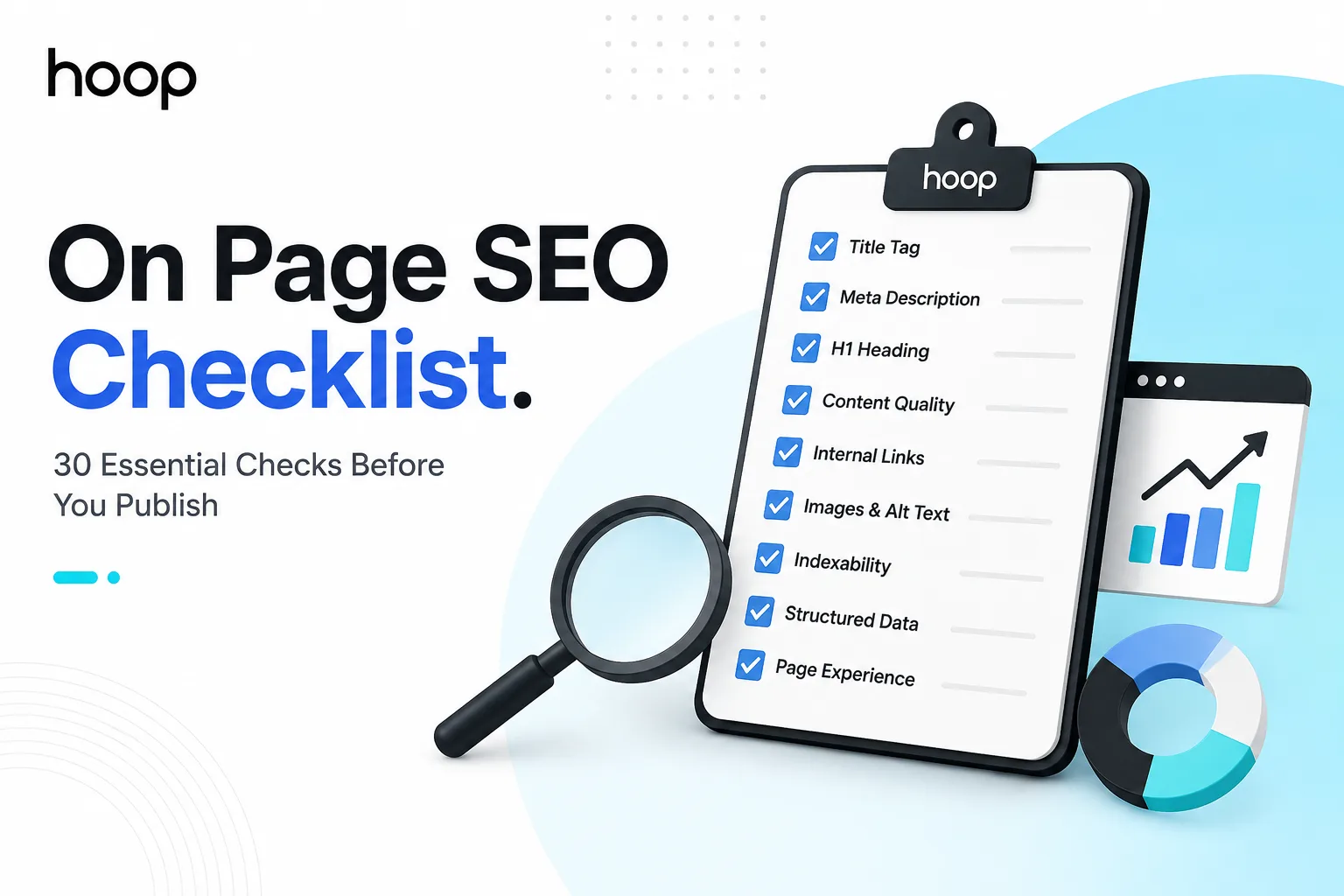
A strong on-page SEO checklist helps you improve every important part of a page. Use this checklist before publishing a new page or updating an old one.
Your page should have:
A clear target keyword<br /> A strong SEO title tag<br /> A useful meta description<br /> One clear H1<br /> Helpful H2 and H3 headings<br /> Natural keyword placement<br /> Useful, original content<br /> Short and clear paragraphs<br /> Internal links to related pages<br /> SEO-friendly URL structure<br /> Optimized images and alt text<br /> Schema markup where useful<br /> Fast loading speed<br /> Mobile-friendly design<br /> Clear calls to action<br /> Easy crawlability and indexing
Now let’s break these down.
Optimize SEO Title Tags
Your title tag is one of the most important on-page SEO factors. It tells search engines and users what the page is about.
The title tag is often the clickable headline in search results. A strong title can improve your click-through rate. A weak title can make users ignore your page, even if it ranks.
A good SEO title tag should:
Include the primary keyword<br /> Match search intent<br /> Be clear and specific<br /> Create a reason to click<br /> Avoid keyword stuffing<br /> Stay close to 50–60 characters when possible
For this article, a strong title is:
On-Page SEO: The Ultimate Optimization Guide for 2026
It includes the main keyword, the topic, and the year. It is clear. It also matches what users want.
Poor title example:
SEO Tips and Tricks
Better title example:
On-Page SEO Guide: How to Optimize Pages in 2026
The better version is more specific. It tells the user what they will get.
Write Better Meta Descriptions
Meta descriptions are short summaries that can appear under your title in search results. They are not always a direct ranking factor, but they can affect clicks.
A good meta description should tell users why the page is worth opening.
It should include the primary keyword naturally. It should also explain the benefit of the page.
Good meta descriptions are:
Clear<br /> Useful<br /> Action-focused<br /> Relevant to the page<br /> Around 150–160 characters when possible<br /> Written for humans, not only search engines
Example:
Learn how on-page SEO works in 2026. Optimize title tags, headings, content, links, images, schema, and user experience.
This works because it tells users exactly what the guide covers.
Avoid vague descriptions like:
We offer the best SEO tips for your website.
That does not explain enough. It also sounds generic.
Use Header Tags Correctly
Header tags help organize your content. They also help users scan the page.
Your page should have one H1. The H1 is the main title. Under that, use H2 headings for main sections. Use H3 headings for smaller points under H2 sections.
This structure helps both search engines and readers.
A clean heading structure looks like this:
H1: Main page title<br /> H2: Main section<br /> H3: Subsection<br /> H3: Subsection<br /> H2: Main section<br /> H3: Subsection
Good header tags make long content easier to read. They also help Google understand how ideas connect.
For example, this article uses H2 sections like “What Is On-Page SEO?” and “Start with Search Intent Before You Optimize.” These headings tell the reader what each section covers.
Do not use headings only for design. Use them for structure.
Place Keywords Naturally
Keyword placement still matters, but it must feel natural.
Your primary keyword should appear in important places, such as:
Title tag<br /> Meta description<br /> H1<br /> Introduction<br /> Some H2 or H3 headings<br /> First 100 words<br /> Body content<br /> Conclusion<br /> Image alt text, when relevant<br /> URL, when possible
However, do not force the keyword into every sentence. That hurts readability and trust.
Use related terms as well. For this topic, related terms include on-page SEO guide, content optimization, internal linking, SEO title tags, meta descriptions, URL structure, and schema markup.
These terms help build topical relevance.
Search engines now understand context better than before. So it is better to write naturally and cover the topic well.
A good rule is simple: write for the user first, then check if the keyword use is clear.
Improve Content Optimization
Content optimization is more than adding keywords. It means making your content more useful, complete, and easy to understand.
A well-optimized page should answer the main question clearly. It should also answer related questions the user may have next.
For example, a page about on-page SEO should not only define the term. It should explain title tags, meta descriptions, headings, content quality, internal links, images, schema, page speed, mobile optimization, and crawlability.
That gives the page depth.
Strong content should be:
Original<br /> Helpful<br /> Clear<br /> Accurate<br /> Easy to scan<br /> Focused on search intent<br /> Supported by examples<br /> Written in simple language<br /> Updated when needed
In 2026, thin content is a real problem. A short page with no depth may struggle to rank, especially in competitive niches.
But long content alone is not enough. A 3,000-word article can still fail if it is full of filler.
Every section should help the reader.
Make Your Content Easy to Read
Readability matters. Users do not want to fight through dense text.
Good SEO content optimization should use short sentences, simple words, and clean formatting. This helps users stay on the page.
To improve readability:
Use short paragraphs<br /> Break long ideas into sections<br /> Use bullets when helpful<br /> Avoid complex words<br /> Add examples<br /> Use clear headings<br /> Write in a natural tone<br /> Remove repeated points<br /> Keep the page focused
This is especially important for service pages and blog content. If users cannot understand your page quickly, they may leave.
A clear page builds trust. A confusing page creates doubt.
Hoop writes SEO content for people first. That is how content earns both rankings and conversions.
Use Internal Linking Strategically
Internal linking means linking from one page on your website to another page on the same website.
This is one of the most useful on-page SEO techniques.
Internal links help users find related content. They also help search engines understand your website structure.
For example, a blog post about on-page SEO can link to pages about technical SEO, SEO audits, content marketing, local SEO, and SEO services.
This helps build a strong content network.
Good internal links should:
Use clear anchor text<br /> Point to useful related pages<br /> Support important service pages<br /> Help users continue their journey<br /> Avoid spammy overlinking<br /> Make your site easier to crawl
Anchor text is the clickable text in a link. Instead of writing “click here,” use clear text like “technical SEO audit” or “SEO content strategy.”
That tells users and search engines what the linked page is about.
Create SEO-Friendly URL Structure
Your URL structure should be short, clear, and easy to read.
A good URL helps users understand the page before they open it. It also helps search engines understand the topic.
Good URL example:
/on-page-seo-guide/
Poor URL example:
/page?id=7829&cat=seo2026/
The first URL is clean. The second one is confusing.
A good SEO-friendly URL should:
Be short<br /> Use the main keyword when natural<br /> Use hyphens between words<br /> Avoid random numbers<br /> Avoid dates unless needed<br /> Match the page topic<br /> Stay easy to read
Do not change old URLs without a reason. If you change a URL, you may need a redirect. Poor redirects can hurt rankings and user experience.
Optimize Images and Alt Text
Images can improve the page experience. They can also help with SEO when used correctly.
Image optimization includes file size, file name, alt text, and image placement.
Large images can slow down your page. Slow pages can hurt user experience. So images should be compressed before upload.
Image file names should be clear. For example:
on-page-seo-checklist.png
This is better than:
IMG_44321.png
Image alt text describes an image for users who cannot see it. It also helps search engines understand the image.
Good alt text example:
On-page SEO checklist showing title tags, meta descriptions, headings, and internal links.
Poor alt text example:
SEO SEO SEO best SEO page SEO
Alt text should be useful, not stuffed with keywords.
Add Schema Markup and Structured Data
Schema markup is code that helps search engines understand the content of your page. It can also help your page appear with rich results in search.
Schema does not guarantee higher rankings. But it can improve how your page is understood.
Common schema types include:
Article schema<br /> FAQ schema<br /> Local business schema<br /> Product schema<br /> Review schema<br /> Service schema<br /> Breadcrumb schema<br /> Organization schema
For a blog post, article schema may help. For a local business page, local business schema may help. For a FAQ section, FAQ schema may help search engines understand your questions and answers.
Structured data should match the visible content on the page. Do not add fake reviews, fake ratings, or misleading schema.
Good SEO is built on trust.
Improve Page Speed and Mobile Experience
Page speed is part of user experience. If your page takes too long to load, users may leave before reading.
This can hurt engagement and conversions.
To improve page speed:
Compress images<br /> Use clean code<br /> Reduce unnecessary scripts<br /> Use browser caching<br /> Improve hosting quality<br /> Remove unused plugins<br /> Use lazy loading<br /> Check Core Web Vitals<br /> Test with PageSpeed tools
Mobile experience is also important. Many users search from phones. If your website is hard to use on mobile, you may lose leads.
A mobile-friendly page should have:
Readable text<br /> Easy buttons<br /> Fast loading<br /> Simple navigation<br /> No broken layout<br /> Clear calls to action<br /> Images that fit the screen
In 2026, mobile optimization is not optional. It is a basic requirement.
Make Pages Easy to Crawl and Index
A page cannot rank if search engines cannot crawl or index it.
Crawlability means search engines can discover the page. Indexing means they can store it and show it in search results.
To support crawlability and indexing:
Use internal links<br /> Submit an XML sitemap<br /> Avoid blocking important pages in robots.txt<br /> Fix broken links<br /> Use clean navigation<br /> Avoid duplicate pages<br /> Use canonical tags when needed<br /> Check Google Search Console<br /> Make important pages easy to reach
Your best pages should not be buried deep inside the website. If a page is important, link to it clearly.
A strong website architecture helps both users and search engines move through your content.
Use Calls to Action
On-page SEO should not only bring traffic. It should help users take action.
A call to action tells the reader what to do next.
Examples include:
Request a free SEO audit<br /> Book a consultation<br /> Get a custom SEO plan<br /> Contact Hoop today<br /> Explore our SEO services<br /> Schedule a strategy call
A good CTA should be clear and helpful. It should not feel forced.
For service pages, CTAs should appear near the top, middle, and end of the page. For blog posts, CTAs can be softer. The goal is to guide users, not pressure them.
SEO brings people to the page. Conversion-focused content helps them become leads.
How AI Search Changes On-Page SEO in 2026
AI search is changing how people find information. Search engines and AI platforms now summarize answers, compare pages, and pull information from many sources.
This does not make on-page SEO less important. It makes it more important.
AI search favors content that is clear, structured, and easy to understand. If your page is vague, messy, or thin, it may not perform well.
To optimize for AI search:
Answer questions clearly<br /> Use helpful headings<br /> Explain terms simply<br /> Add direct summaries<br /> Use structured data<br /> Cover related questions<br /> Keep content accurate<br /> Avoid fluff<br /> Build topical authority<br /> Use natural language<br /> Include original insights
AI search tools need clear information. So do human users.
This is why Hoop focuses on content that works for people, search engines, and AI-driven search experiences.
Common On-Page SEO Mistakes to Avoid
Even good websites make basic mistakes. These errors can limit rankings and traffic.
Mistake 1: Keyword Stuffing
Using the same keyword too many times makes content sound robotic. It can also hurt trust.
Use keywords naturally. Add related terms. Focus on meaning.
Mistake 2: Weak Title Tags
A vague title tag can reduce clicks. Each page should have a unique title that matches search intent.
Mistake 3: Missing Meta Descriptions
A missing meta description gives search engines no clear summary to use. Write a useful one for every important page.
Mistake 4: Poor Heading Structure
Do not use many H1 tags. Do not skip structure. Use H2 and H3 headings to guide the reader.
Mistake 5: Thin Content
Thin content gives little value. It may not answer the search query fully.
Improve weak pages with examples, FAQs, better structure, and deeper information.
Mistake 6: No Internal Links
Pages without internal links may be harder to find. Use internal links to connect related content.
Mistake 7: Slow Pages
Slow pages hurt user experience. Compress images, clean code, and improve performance.
Mistake 8: Ignoring Mobile Users
A page that looks good on desktop but poor on mobile can lose traffic and leads.
Mistake 9: No Clear CTA
Traffic without action is wasted. Every important page should guide users toward the next step.
Mistake 10: Writing for Search Engines Only
Good content must help real people. If users do not trust the page, rankings alone will not help.
How Hoop Builds Better On-Page SEO
At Hoop, on-page SEO optimization is not treated as a checklist alone. It is treated as part of a full growth system.
A page must rank, but it must also serve the user. It must answer the right question, support the buyer journey, and help the business get measurable results.
Hoop focuses on:
Search intent research<br /> Keyword mapping<br /> SEO title tags<br /> Meta descriptions<br /> Header tags<br /> Content structure<br /> Content optimization<br /> Internal linking<br /> URL structure<br /> Image optimization<br /> Schema markup<br /> Technical SEO support<br /> Mobile experience<br /> Conversion-focused copy<br /> Performance tracking
This approach helps each page become stronger over time.
A good SEO page should not feel like it was written for an algorithm. It should feel useful, clear, and human.
That is the kind of content search engines can trust and users can act on.
Simple On-Page SEO Checklist Before Publishing
Before you publish or update a page, check these points:
Is the main keyword clear?<br /> Does the title tag include the keyword?<br /> Is the meta description useful?<br /> Is there only one H1?<br /> Are H2 and H3 headings used properly?<br /> Does the content match search intent?<br /> Are keywords used naturally?<br /> Is the content easy to read?<br /> Are internal links added?<br /> Is the URL short and clear?<br /> Are images compressed?<br /> Does each important image have alt text?<br /> Is schema added where useful?<br /> Does the page load fast?<br /> Does it work well on mobile?<br /> Can Google crawl and index it?<br /> Is there a clear CTA?
This checklist is simple, but it covers the core of modern on-page SEO.
Conclusion
On-page SEO is one of the most important parts of digital growth in 2026. It helps search engines understand your pages and helps users find the answers they need. When done well, it can improve rankings, organic traffic, user experience, and conversions.
The best results come from a complete approach. Optimize your title tags, meta descriptions, header tags, content, keywords, internal links, URLs, images, schema, page speed, mobile experience, and crawlability.
But do not optimize only for search engines. Optimize for people first. Give clear answers. Use simple language. Make the page easy to scan. Guide users toward the next step.
If your business wants stronger rankings, better content, and a smarter SEO strategy, Hoop can help you build pages that work for search engines, AI platforms, and real customers.
Start with one page. Improve it fully. Then keep going. That is how on-page SEO optimization becomes long-term organic growth.
Meta Title:On-Page SEO: The Ultimate Optimization Guide for 2026
Excerpt: On-page SEO helps your pages rank higher, attract better traffic, and convert visitors into leads. This 2026 guide explains title tags, meta descriptions, headings, content optimization, internal links, URLs, images, schema, page speed, mobile experience, and AI search visibility.
“Good optimization in 2026 means better structure, useful content, clean links, fast pages, and strong search intent.”
Key takeaways
- 01Start with search intent before optimizing anything
- 02Nail title tags, meta descriptions, and header structure
- 03Place keywords naturally and keep content readable and useful
- 04Support it with internal links, clean URLs, image alt text, and schema
Written by
Sahar
Content Writer
Frequently Asked
Questions
Everything you need to know before booking a strategy call. Can't find your answer? Contact us directly.
On-page SEO is the process of optimizing a web page so it can rank better in search engines. It includes content, title tags, meta descriptions, headings, keywords, internal links, images, URLs, schema, and user experience.
On-page SEO is important because it helps search engines understand your page. It also helps users find clear answers. Better on-page optimization can improve rankings, traffic, clicks, and conversions.
The most important on-page SEO factors include search intent, content quality, title tags, meta descriptions, header tags, keyword placement, internal linking, URL structure, image optimization, schema markup, page speed, and mobile experience.
Start with search intent. Then optimize the title tag, meta description, headings, content, internal links, URL, images, and schema. Also make sure the page is fast, mobile-friendly, and easy to crawl.
A page should usually have one H1 tag. The H1 should describe the main topic of the page. Use H2 and H3 headings for supporting sections.
Meta descriptions are not usually a direct ranking factor, but they can affect clicks. A better description can make more users choose your result in search.
Use keywords naturally in the title, meta description, H1, introduction, headings, body content, conclusion, and image alt text when relevant. Avoid keyword stuffing.
Internal linking helps users find related pages. It also helps search engines understand your site structure and discover important pages.
An SEO-friendly URL is short, clear, and easy to read. It should describe the page topic and may include the main keyword when natural.
Yes. Page speed affects user experience. Slow pages can increase exits and reduce conversions. Fast pages are better for users and search performance.
AI search rewards clear, useful, and well-structured content. Pages should answer questions directly, use clear headings, include structured data, and cover topics with depth.
Important pages should be reviewed regularly. Update content when information changes, rankings drop, competitors improve, or new search intent appears.