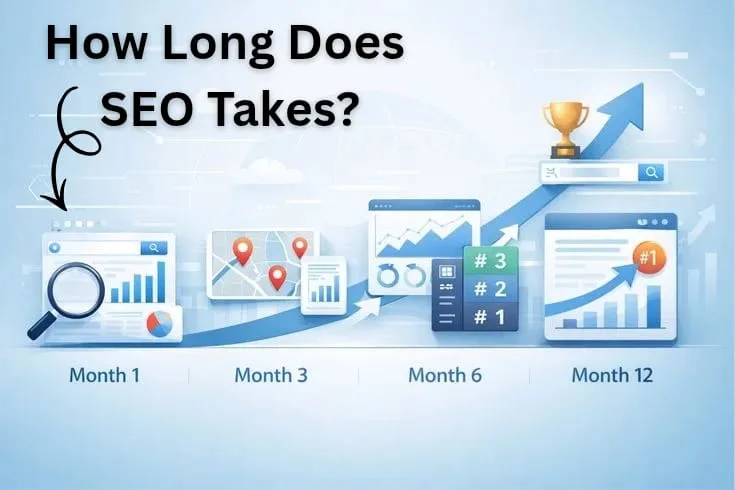
How Long Does SEO Take? Realistic Timeline for 2026
SEO is a long game: expect early signals by months 2–3, measurable results by 3–6 months, and compounding growth after a year. Your timeline depends on your site, competition, content, and authority.
Sahar
Content Writer
If you are asking how long does SEO take, you want a clear answer. Most websites need 3–6 months to see real SEO progress. Strong traffic, leads, and ROI often take 6–12 months or more. The exact timeline depends on your website, competition, content, authority, and SEO strategy.
Need this done right?
Hoop builds the strategy, design and development behind sites like this one — talk to us about yours.
The Short Answer: How Long Does SEO Take?
In most cases, SEO takes 3 to 6 months to show measurable results. These results may include better keyword rankings, more impressions, more organic clicks, and early leads.
However, stronger business results usually take longer. For many companies, the real growth comes between 6 and 12 months. This is when organic traffic growth becomes more stable. It is also when service pages, blog content, local SEO, and backlinks begin to work together.
A simple SEO timeline looks like this:
Month 1: SEO audit, keyword research, and technical fixes<br /> Months 2–3: Page updates, content planning, and early ranking movement<br /> Months 3–6: More impressions, clicks, and keyword growth<br /> Months 6–12: Stronger traffic, leads, and conversions<br /> After 12 months: Compounding growth and better SEO ROI
SEO is not instant. It is a long-term growth system. That is why the best question is not only “how long does SEO take?” The better question is, “What should happen at each stage of my SEO campaign?”
When you know the stages, you can track progress without panic. You can see whether your campaign is moving in the right direction before big revenue numbers appear.
Why SEO Takes Time
SEO results take time because search engines do not rank a website after one small change. Google needs to crawl your website, index your pages, understand your content, compare your site with competitors, and measure trust signals.
That process is slow for a reason. Search engines want to show users the best answer. So they look at many signals before they place your page near the top.
Search Engines Need to Crawl and Index Your Pages
Before your page can rank, Google must find it. This is called crawling. After that, Google must store and understand it. This is called indexing.
If your site has poor internal linking, broken pages, slow loading speed, or crawl errors, this step can take longer. That is why technical SEO is so important in the first month of a campaign.
A strong site structure helps search engines move through your website with ease. It also helps users find the right pages without confusion.
Google Needs to Understand Search Intent
Ranking is not only about keywords. It is also about search intent.
Search intent means what the user really wants. For example, a person searching “how long does SEO take” wants a realistic timeline. They may also want to know why SEO takes time, what results to expect, and how to speed things up.
If your page answers the query better than your competitors, it has a better chance to rank. If your page is thin, vague, or too sales-focused, it may struggle.
Good SEO content must help the reader first. Keywords support the content. They should not control it.
Authority and Trust Build Slowly
Search engines also look at trust. A website with helpful content, strong backlinks, good user experience, and a clear brand presence is easier to trust.
This is why a new website often takes longer to rank. It has no history. It has fewer backlinks. It has fewer pages. It also has fewer trust signals.
An older website with strong content and a clean backlink profile may see faster results. But even then, SEO still needs time.
Competition Affects the SEO Timeline
A small local business may rank faster than a national company. A plumber in one city may get results sooner than a software brand trying to rank across the country.
High-competition keywords take longer. Low-competition and long-tail keywords can move faster.
For example, ranking for “SEO services” is hard. Ranking for “local SEO services for small businesses” may be easier. It is more specific. It also has stronger buying intent.
That is why a smart SEO strategy does not chase only big keywords. It builds growth through realistic keyword targets first.
Month 1: SEO Audit, Research, and Planning
The first month is about building the base. A serious campaign should not begin with random blog posts. It should begin with a clear audit.
This stage includes:
Website audit<br /> Technical SEO review<br /> Keyword research<br /> Competitor research<br /> Content gap analysis<br /> Internal link review<br /> Backlink profile check<br /> Google Search Console review<br /> Conversion path review<br /> Local SEO review, if needed
This first month may not bring huge traffic. That is normal. You are fixing the foundation.
A weak foundation can slow down the whole campaign. If your website has crawl issues, duplicate pages, poor title tags, missing meta descriptions, or slow pages, new content may not perform well.
This is why month one matters. It helps your team understand where the website stands now and what needs to improve first.
At the end of this stage, you should have a clear roadmap. You should know which pages need updates, which keywords matter, what content is missing, and which technical issues need attention.
Months 2–3: Technical SEO and Early Signals
During months two and three, the real work begins. Your team starts fixing errors, improving pages, and publishing or updating content.
This stage often includes:
Fixing crawl errors<br /> Improving page speed<br /> Updating title tags and meta descriptions<br /> Improving headings<br /> Adding internal links<br /> Optimizing service pages<br /> Refreshing old content<br /> Creating new content briefs<br /> Improving mobile experience<br /> Cleaning thin or duplicate pages
At this stage, you may start to see early signs of progress. These signs may not look huge, but they matter.
You may see more impressions in Google Search Console. Some keywords may move from no ranking to page four or page three. Existing pages may improve by a few positions. Long-tail keywords may bring early clicks.
These are called early SEO signals. They show that Google is noticing your website changes.
This is also the stage where many business owners get impatient. They expect leads right away. But SEO often moves in steps.
First, Google sees the page. Then it tests the page. Then rankings move. Then clicks grow. Then leads begin.
So, if your impressions and rankings improve in months two and three, your SEO results timeline may be on track.
Months 3–6: Measurable SEO Results Start
Months three to six are often the turning point. This is when many websites begin to see measurable results.
You may see:
More organic impressions<br /> Better keyword rankings<br /> More organic traffic<br /> More long-tail keyword clicks<br /> More local visibility<br /> Better service page performance<br /> More calls or form submissions<br /> More blog traffic<br /> More branded searches
This does not mean every page will rank on page one. It means the campaign is gaining traction.
At this stage, content quality becomes very important. Search engines need to see that your website covers the topic in depth. One page alone is often not enough.
For example, if Hoop wants to rank for SEO services, the website should not only have one SEO service page. It should also have related content on technical SEO, local SEO, ecommerce SEO, SEO timelines, SEO audits, keyword research, content strategy, and link building.
This creates topical authority. It tells search engines that your website is not covering the topic lightly. It is covering it with depth.
That depth helps rankings grow over time.
Months 6–12: Stronger Growth, Leads, and ROI
Between six and twelve months, SEO can become a strong business channel. This is where the work from earlier months begins to compound.
Your optimized service pages have more time to rank. Your blog content has more time to gain impressions. Internal links help important pages. Backlinks and brand mentions help build authority. Users begin to spend more time on helpful pages.
This is when organic traffic growth can become more predictable.
You may see:
Higher rankings for money keywords<br /> More traffic to service pages<br /> More qualified leads<br /> Better local map visibility<br /> Improved conversion rates<br /> More traffic from blog clusters<br /> Better SEO ROI<br /> More stable ranking positions
The goal at this stage is not just traffic. The real goal is business impact.
A good SEO campaign should help people find your business, trust your offer, and take action. That action may be a call, form fill, booked consultation, quote request, or online sale.
This is why SEO and conversion strategy must work together. Traffic alone is not enough. The page must also guide the visitor toward the next step.
After 12 Months: SEO Starts to Compound
After one year, a strong SEO campaign can become one of the best growth assets a business owns.
This does not mean the work stops. SEO is ongoing. Competitors keep publishing content. Google keeps changing. User behavior changes. AI search is also changing how people discover answers.
But after 12 months, your website may have a stronger base. It may have more content, more links, better rankings, and more trust.
This creates compounding growth.
Compounding means each new SEO effort can support the work already done. A new blog post can support a service page. A new internal link can lift an older page. A content update can help a page move higher. A new backlink can improve authority across the site.
That is the power of long-term SEO. It does not vanish the moment you stop paying for a click.
Paid ads stop when the budget stops. SEO can keep bringing traffic after the work is done, as long as the website stays useful and updated.
New Website vs Existing Website: Which Takes Longer?
A new website usually takes longer to rank. It has no history, fewer backlinks, and less trust. Search engines need more time to understand it.
For a new website, a realistic SEO timeline may look like this:
0–3 months: Setup, indexing, and early visibility<br /> 3–6 months: Long-tail keyword growth<br /> 6–12 months: Stronger traffic and lead growth<br /> 12+ months: Competitive keyword growth
This does not mean a new site cannot get results sooner. It can. But it must target the right keywords first.
A new site should focus on long-tail keywords, local keywords, and lower-competition topics. These are easier to rank for. They also bring more focused visitors.
An existing website may move faster. It may already have pages, backlinks, traffic, and some rankings. In that case, SEO can improve what already exists.
For an existing website, fast wins may come from:
Updating old pages<br /> Improving title tags<br /> Adding FAQs<br /> Improving internal links<br /> Fixing technical SEO issues<br /> Expanding thin content<br /> Improving page speed<br /> Targeting page two keywords<br /> Refreshing outdated blog posts
Existing websites often have hidden value. A good SEO audit can reveal pages that are close to ranking. These pages can often improve faster than brand-new content.
Local SEO Timeline
Local SEO can move faster than national SEO because the competition is limited by location. A local business is not trying to rank across the whole country. It is trying to rank in a city, area, or service region.
For many local businesses, early movement can happen within two to four months. Stronger results often take six months or more.
Local SEO depends on many factors, such as:
Google Business Profile optimization<br /> Local landing pages<br /> Customer reviews<br /> Local citations<br /> Service area pages<br /> On-page SEO<br /> Local backlinks<br /> Name, address, and phone consistency<br /> Website quality<br /> Map pack competition
If your Google Business Profile is weak, your local rankings may suffer. If your website is not clear about your services and locations, Google may not know when to show your business.
A strong local SEO campaign connects your website, content, reviews, and business profile. When all of these signals match, your local visibility can grow.
National SEO Timeline
National SEO takes longer because the competition is wider. You are not only competing with nearby businesses. You are competing with brands, directories, publishers, marketplaces, and older websites.
For national campaigns, SEO takes 6 to 12 months for stronger growth in many cases. For very competitive industries, it may take longer.
National SEO needs:
Strong content hubs<br /> Deep keyword research<br /> High-quality service pages<br /> Consistent publishing<br /> Authority building<br /> Digital PR or link building<br /> Technical SEO strength<br /> Clear brand positioning<br /> Conversion-focused pages
National SEO is not about one page. It is about building a full search presence.
That means your website should answer the key questions your audience asks at every stage. Some users are just learning. Some are comparing options. Some are ready to buy.
Your content should support all three stages.
Ecommerce SEO Timeline
Ecommerce SEO can also take time because online stores often have more technical issues. Product pages, category pages, filters, duplicate content, site speed, and crawl budget can all affect performance.
An ecommerce SEO timeline often looks like this:
Month 1: Technical audit and keyword research<br /> Months 2–3: Category page optimization and technical fixes<br /> Months 3–6: Product and collection page improvements<br /> Months 6–12: Stronger organic traffic and sales growth
For ecommerce sites, category pages are often more important than product pages. Product pages may change, go out of stock, or have similar descriptions. Category pages are more stable and can target high-value keywords.
A good ecommerce SEO strategy should improve:
Category page content<br /> Product descriptions<br /> Internal links<br /> Schema markup<br /> Image optimization<br /> Site speed<br /> Mobile usability<br /> Duplicate content<br /> Faceted navigation<br /> Conversion paths
Ecommerce SEO should not only bring traffic. It should bring buyers.
What Affects the SEO Results Timeline?
Many things affect how long SEO takes to work. Some are easy to fix. Others take more time.
Website Health
A healthy website ranks faster. If your site is slow, hard to crawl, or full of errors, results can be delayed.
Technical SEO gives your content a better chance to rank. Without it, even good content may struggle.
Competition Level
The harder the keyword, the longer it takes. Competitive keywords need stronger content, better links, and more authority.
A smart SEO plan targets both quick wins and long-term goals.
Content Quality
Good content answers the question fully. It is clear, helpful, and easy to read. It also matches search intent.
Thin content may rank for a short time, but it will not build long-term trust.
Backlink Profile
Backlinks are links from other websites to your site. They can help build authority. But quality matters more than quantity.
Relevant links from trusted sites are better than cheap links from weak sites.
Domain Age and History
Older domains may have more trust. New domains need more time. But age alone is not enough.
A new website with strong SEO can beat an old website with weak content and poor structure.
Implementation Speed
SEO plans do not work unless they are implemented. If technical fixes, content updates, and page changes take months to approve, results will also take longer.
Fast and clean execution helps SEO move faster.
User Experience
Google wants to rank pages that users can use with ease. If your site is slow, confusing, or hard to read on mobile, users may leave.
Good SEO and good user experience go together.
Can You Speed Up SEO Results?
Yes, you can speed up SEO results. But you cannot force them overnight.
The goal is to remove delays and make smarter moves.
Here are safe ways to improve your SEO results timeline:
Fix technical issues first<br /> Improve pages that already rank<br /> Target long-tail keywords<br /> Build topic clusters<br /> Add strong internal links<br /> Refresh old content<br /> Create clear service pages<br /> Improve page speed<br /> Optimize for mobile users<br /> Earn relevant backlinks<br /> Improve Google Business Profile<br /> Use Search Console data<br /> Track conversions, not only traffic
One of the fastest SEO wins is updating pages that already rank on page two or three. These pages are close to better visibility. A better title, stronger content, improved FAQs, and better internal links can help them move.
Another fast win is improving pages that get impressions but few clicks. This may mean the title or meta description is weak. Better copy can improve click-through rate.
SEO is slow when it is random. It is faster when every action has a clear reason.
What SEO Results Should You Expect First?
SEO usually improves in stages. Leads and sales are not always the first sign.
The usual order is:
More pages indexed<br /> More impressions<br /> Better keyword rankings<br /> More clicks<br /> More organic traffic<br /> More engaged visitors<br /> More leads<br /> More sales<br /> Better ROI
This order matters. If impressions are rising, your site is becoming more visible. If rankings are improving, your pages are gaining strength. If clicks are growing, users are choosing your result.
Leads may come after these early signals.
That is why businesses should not judge SEO only by sales in month one. A proper SEO campaign tracks several signs of progress.
What Should You Track During an SEO Campaign?
To know if SEO is working, track the right metrics.
Important SEO metrics include:
Organic impressions<br /> Organic clicks<br /> Keyword rankings<br /> Click-through rate<br /> Indexed pages<br /> Top landing pages<br /> Technical errors<br /> Page speed<br /> Backlinks<br /> Local rankings<br /> Form submissions<br /> Phone calls<br /> Quote requests<br /> Online sales<br /> SEO ROI
Google Search Console is one of the most useful tools for tracking early progress. It shows how often your pages appear in search, what users click, and which keywords are gaining visibility.
Google Analytics can show what users do after they land on your website. This helps connect SEO traffic to leads and sales.
Rank tracking tools can help show keyword movement. But rankings alone do not tell the full story. A keyword may rank well but bring no leads. Another keyword may have lower volume but better intent.
The best SEO tracking connects visibility, traffic, and conversions.
When Should You Worry That SEO Is Not Working?
SEO takes time, but it should not feel invisible forever.
After one month, you should expect planning, audits, and early fixes. You may not see major traffic yet.
After three months, you should usually see some early movement. This may include more impressions, better indexing, or keyword improvements.
After six months, you should expect clearer progress. If nothing has changed by then, the strategy needs review.
SEO may not be working if:
No technical fixes were made<br /> No content was improved<br /> No new pages were created<br /> No keyword strategy exists<br /> Rankings are not moving<br /> Impressions are flat<br /> The site has crawl issues<br /> The content is too thin<br /> The wrong keywords are targeted<br /> There is no internal linking plan<br /> No conversions are being tracked
A lack of results does not always mean SEO cannot work. It may mean the campaign needs better direction.
Sometimes the issue is not SEO itself. It is poor execution.
SEO vs Paid Ads: Which Works Faster?
Paid ads work faster. SEO lasts longer.
With paid ads, you can get traffic as soon as your campaign starts. But once you stop paying, the traffic stops.
SEO takes longer, but it can keep working over time. A well-ranked page can bring traffic for months or even years if it stays useful.
The best growth strategy often uses both.
Paid ads can bring quick leads. SEO can build long-term visibility. Together, they can support the full customer journey.
However, businesses should not expect SEO to behave like ads. SEO is not instant traffic. It is asset building.
Each optimized page becomes a digital asset. Each helpful article can bring search traffic. Each strong backlink can support authority. Each local page can help a service area grow.
That is why SEO is a long-term investment.
How AI Search Affects SEO in 2026
In 2026, search is changing. AI search features now answer many questions directly. This changes how users discover content.
But SEO is not dead. It is becoming more focused on quality, clarity, and trust.
To perform well in traditional and AI search, your content should be:
Clear<br /> Helpful<br /> Well-structured<br /> Easy to scan<br /> Based on real expertise<br /> Updated often<br /> Focused on search intent<br /> Supported by strong internal links<br /> Written for people first
AI search often pulls from content that is easy to understand. That means vague content will struggle. Generic content will also struggle.
Your website needs strong answers, clear headings, useful examples, and original insight.
For businesses, this means SEO and AIO now work together. AIO means AI optimization. It helps your content become easier for AI discovery platforms to understand.
Hoop focuses on SEO that works for both search engines and real users. That matters more than ever.
Common SEO Timeline Myths
Many businesses have wrong ideas about SEO. These myths lead to bad choices.
Myth 1: SEO Works in a Few Days
Some small changes can be noticed quickly. But real SEO growth takes time. Rankings, traffic, and leads do not usually appear in a few days.
Myth 2: More Content Means Faster Results
More content is not always better. Better content is better.
A few strong pages can beat dozens of weak posts. Quality, intent, and structure matter.
Myth 3: Backlinks Alone Can Rank a Website
Backlinks help, but they are not the whole strategy. If your content is weak or your site has technical issues, links alone may not solve the problem.
Myth 4: SEO Is a One-Time Task
SEO is not a one-time setup. It needs updates, tracking, content improvements, technical checks, and strategy changes.
Myth 5: Traffic Is the Only Goal
Traffic is useful, but leads matter more. A good SEO campaign brings the right visitors, not just more visitors.
How Hoop Builds a Smarter SEO Timeline
At Hoop, SEO is not treated as guesswork. It is treated as a growth system.
A smart campaign starts with research. Then it moves into technical fixes, content planning, on-page SEO, local SEO, link building, and conversion improvement.
The goal is not to promise overnight rankings. The goal is to build real, steady growth.
Hoop helps businesses by focusing on:
Clear SEO audits<br /> Keyword research based on intent<br /> Content that matches the buyer journey<br /> Technical SEO improvements<br /> Local SEO strategy<br /> On-page optimization<br /> Internal linking<br /> Conversion-focused service pages<br /> Search Console tracking<br /> Long-term growth planning
This approach helps businesses understand what is happening at every stage.
You should know what was fixed, what was improved, what is ranking, what is gaining traffic, and what still needs work.
SEO should never feel like a mystery.
A Realistic SEO Timeline by Business Type
Different businesses need different timelines. There is no single answer for every website.
Small Local Business
A small local business may see early movement in 2–4 months. Stronger lead growth may take 4–8 months.
This depends on reviews, local competition, Google Business Profile, and location pages.
Service-Based Business
A service business may need 3–6 months for clear movement and 6–12 months for stronger results.
Service pages, blog content, and local or national keywords all matter here.
Ecommerce Store
An ecommerce store may need 6–12 months for strong results. Larger stores may take longer because technical issues are more complex.
Category pages, product content, filters, and site speed matter a lot.
New Brand
A new brand may need 9–12 months or more to compete for strong keywords. It must build trust from the ground up.
The best path is to start with long-tail and niche keywords.
Established Website
An established website may see results faster if it already has authority. Some improvements may show in 2–3 months.
The fastest wins often come from improving existing pages.
How to Know If Your SEO Timeline Is Realistic
A realistic SEO timeline should be based on data. It should not be based on hope.
Before setting expectations, look at:
Website age<br /> Current traffic<br /> Current rankings<br /> Technical issues<br /> Content quality<br /> Competitor strength<br /> Backlink profile<br /> Keyword difficulty<br /> Local competition<br /> Industry type<br /> Budget and execution speed
If your competitors have hundreds of strong pages and many backlinks, your website may need time. If your site is already close to ranking, results may come sooner.
A good SEO team will not promise page-one rankings in 30 days. They will explain what can happen first, what may take longer, and what work is needed.
That honesty is important.
Conclusion: So, How Long Does SEO Take?
The realistic answer is simple. How long does SEO take? Most websites need 3–6 months to see clear progress. Stronger traffic, leads, and ROI often take 6–12 months or more.
The timeline depends on your website health, competition, content quality, backlinks, domain history, and execution speed.
SEO is not a quick trick. It is a long-term growth system. When it is done well, it builds visibility, trust, traffic, and leads that can keep growing over time.
If your business wants a clear SEO strategy, better search visibility, and steady organic traffic growth, Hoop can help you build a realistic plan that works beyond short-term clicks.
Start with the right foundation. Build useful content. Fix technical issues. Track the right numbers. Stay consistent.
That is how SEO turns from a waiting game into a growth channel.
Meta Title: How Long Does SEO Take? Realistic SEO Timeline for 2026
“Most websites need 3–6 months to see real SEO progress, and 6–12 months or more for strong traffic, leads, and ROI.”
Key takeaways
- 01Most websites need 3–6 months for real progress; strong ROI often takes 6–12 months or more
- 02New sites and competitive niches take longer than established ones
- 03Local SEO usually shows results faster than national or ecommerce SEO
- 04You can speed it up with technical fixes, better content, and authority — not shortcuts
Written by
Sahar
Content Writer
Frequently Asked
Questions
Everything you need to know before booking a strategy call. Can't find your answer? Contact us directly.
SEO takes 3 to 6 months to show measurable progress in most cases. Stronger traffic, leads, and ROI often take 6 to 12 months or more.
SEO can show early signs in one month, such as better indexing or more impressions. But major ranking and traffic growth usually takes longer.
It can take a few weeks to several months to rank on Google. Competitive keywords may take 6–12 months or more.
SEO takes time because Google needs to crawl, index, test, and compare your pages. Your website also needs authority, content depth, and trust signals.
Local SEO can show early movement in 2–4 months. Stronger map rankings and lead growth often take 4–8 months or more.
Ecommerce SEO usually takes 6–12 months for strong growth. Large stores or competitive niches may take longer.
SEO is working if impressions, rankings, clicks, organic traffic, and conversions improve over time. Early progress often starts with impressions and ranking movement.
Yes. You can speed up results by fixing technical issues, improving existing pages, targeting long-tail keywords, building internal links, and publishing helpful content.
SEO is better for long-term organic growth. Paid ads are faster, but the traffic stops when the budget stops. Many businesses benefit from using both.
Yes. SEO still matters in 2026. Search is changing, but businesses still need clear, helpful, trusted content that can be found by users and search engines.